

As a marketer today, you face the challenge of reaching your target audience across many channels: social media, email, digital ads, print ads, commercials and more. How can you establish an overarching brand identity on all these platforms? With integrated marketing campaigns, you deliver a unified message across platforms, ensuring customers get consistency from your brand at every touchpoint.
The field of integrated marketing communications was pioneered at Northwestern University’s Medill School of Journalism, Media, Integrated Marketing Communications (as the name suggests) by Don Schultz. He was among the first researchers to observe a shift away from traditional advertising methods toward a more strategic, holistic approach to marketing.1 His legacy continues to shape how marketers coordinate messaging across all marketing and advertising platforms, focusing on a unified brand message and coherent engagement with the customer.
The multichannel approach was considered revolutionary thinking in the ’80s and ’90s. Today, it’s a marketing fundamental: A brand that isn’t in control of its messaging across proliferating digital and analog platforms risks getting lost in the noise created by multiple competing messages and media.
This blog post explores the essentials of integrated marketing campaigns. Learn how they help power successful brands in the modern era.
Core Elements of an Integrated Marketing Campaign
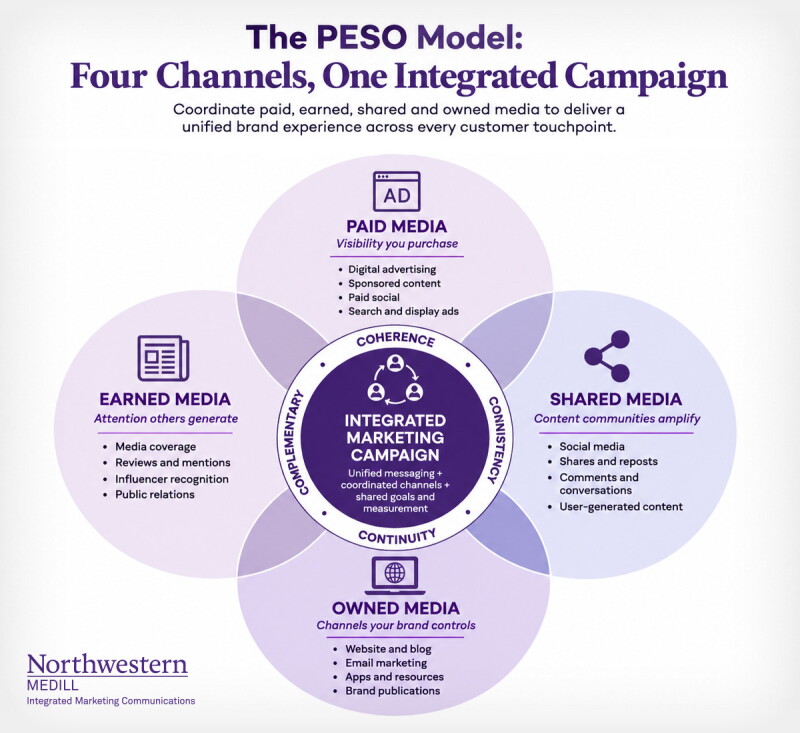
At the core of every integrated marketing communications campaign is a set of principles called “the four Cs of IMC”:2
- Coherence: A clear and logical connection between communications across all channels
- Consistency: Messaging is mutually supportive, not contradictory
- Continuity: Marketing efforts remain coherent and consistent over time
- Complementary: Multichannel messaging is synergistic, adding up to something greater than the sum of its parts
This is what makes an advertising campaign an integrated campaign: Unified messaging across all channels, supported by consistent branding and visuals, and a strategic alignment of goals and metrics.
These core elements contribute to brand trust, one of the most important concepts in IMC. Brand trust is consumer respect built on a brand’s demonstration of trustworthiness (through qualities such as consistency), which can evolve into brand loyalty.3
How Integrated Campaigns Work
A successful integrated advertising campaign coordinates digital, print, social and experiential marketing to deliver unified messaging. Marketers often present this in terms of the PESO Model, coordinating and optimizing paid, earned, shared and owned media.4
Under the PESO Model, paid media is essentially traditional advertising: The content your company pays to put out there, such as paid ads. Earned media is analogous to PR: It’s the coverage you get for your brand from other media sources, through creative storytelling and engagement. Shared media is social media. It’s the content that your audience likes, shares, retweets and forwards on various platforms. Owned media is controlled directly by your brand, such as your website.
Coordinate messaging across the PESO channels, harness data analytics and AI marketing tools to monitor performance and facilitate tweaks to your strategy, and you have an integrated marketing campaign.
When successfully executed, the results can be stunning. The “Share a Coke” campaign started in Australia in 2011 and spread around the world. By 2014, Coca-Cola estimated that 94% of the population of the UK had seen Share a Coke ads at least 20 times.5 The campaign was credited with an 11% uplift in Coke sales in the U.S. and was refreshed for 2025, spreading to new social media platforms and engaging a new generation of Coke drinkers.6
Through consistent messaging across paid, earned, shared and owned media, Coca-Cola’s integrated marketing campaign managed the almost unthinkable: It grew recognition and sales for one of the world’s most mature brands.
Benefits of Integrated Marketing Campaigns
The Share a Coke campaign illustrates the potential benefits of an effective integrated marketing campaign. Through cohesive messaging built around an engaging, personalized campaign (the Coke logo was replaced by popular names on bottles and cans, encouraging customers to find a name meaningful to them), Coke built stronger brand awareness and recall, prompting higher engagement and conversion rates.6
Coca-Cola uses “at least one Coke consumed in the past four weeks” as the brand’s key performance indicator. Over eight weeks in the summer of 2014, that traditionally static metric moved up five points among teens, translating to 1.25 million more teens trying a Coke during that period.6
The campaign ultimately delivered an 11% increase in sales revenue and volume for Coke in the USA, including the best four-week sales period for the brand since 2009 and the best year-on-year sales increase in the brand’s recorded history.6
Key Steps to Building an Integrated Campaign
Building an integrated campaign requires marketers to think strategically, starting with an in-depth understanding of their target audience and clear objectives for the campaign. From this starting point, you can go on to develop a channel strategy, choosing the right mix of marketing channels to engage your audience.7
Once you’ve identified your audience, objectives and channel mix, the next step is to develop content. A good integrated campaign will have a strong cross-channel strategy, making use of content that is sufficiently agile to be deployed across multiple media.7
Finally, marketers must set Key Performance Indicators (KPIs) as metrics to guide the ongoing measurement of the campaign’s effectiveness, providing a basis for decisions to refine tactics or strategy over time.7
Launch Your Career in Marketing With Medill
What is an integrated marketing campaign? Fundamentally, it’s a customer-centric and data-driven, multichannel exercise that is intended to drive measurable marketing success.
If you’re a marketing professional or career-changer who wants to acquire the skills and tools necessary to develop unified strategies that deliver lasting brand impact, it might be time to enroll in Medill’s Master of Science in Integrated Marketing Communications Professional program. A flexible program for working professionals with a minimum of three years of work experience, the live-online IMC Professional program builds elite skills in client management, data analysis, leadership and strategic thinking.
If you’re ready to join the latest generation of integrated marketing communications pros, review Medill’s admission requirements online, or contact us directly for more information. For a more detailed discussion of what Medill can do for you, schedule a call with one of our admissions outreach advisors.
- Retrieved on July 31, 2026, from medium.com/jimc-2021/standing-on-the-shoulders-of-a-giant-remembering-don-schultz-9387ac50524e
- Retrieved on July 31, 2026, from smartinsights.com/traffic-building-strategy/integrated-marketing-communications/
- Retrieved on July 31, 2026, from advertising.amazon.com/library/guides/brand-trust
- Retrieved on July 31, 2026, from forbes.com/councils/forbescommunicationscouncil/2022/11/09/what-is-the-peso-model-in-marketing/
- Retrieved on July 31, 2026, from marketingweek.com/coca-cola-personalised-share-a-coke/
- Retrieved on July 31, 2026, from mrs.org.uk/pdf/US_COCA_COLA_-_FINAL_TWO.pdf
- Retrieved on July 31, 2026, from camphouse.io/blog/integrated-marketing-campaign#h-how-to-build-an-effective-integrated-marketing-campaign